

Nutanix: Invisible Wires: Agentic Cloud
When everyone talks to one box: catching incast and letting X-Play clean it up
A storage rebuild starts. Five nodes begin sending to one. Every individual link is fine, every VM looks healthy, and yet one host's uplink is pinned flat and the application on it feels like it is running through wet concrete. Nothing is broken. Too many senders are talking to the same box at the same time.
That pattern has a name: incast. Many senders, one receiver, one port that can't keep up. It shows up in RDMA fabrics as pause storms, and in ordinary TCP traffic as dropped packets and retransmits. Storage rebuilds, backup windows, database shuffles and a hot NFS export all produce it.
This post walks through a small, repeatable exercise: create incast on purpose, detect it, and let Nutanix X-Play fix it without a human touching anything. Then prove it worked. Status: the design and the playbook are below; the demo has not been recorded yet, so there are no measured results in this post.
The whole system first
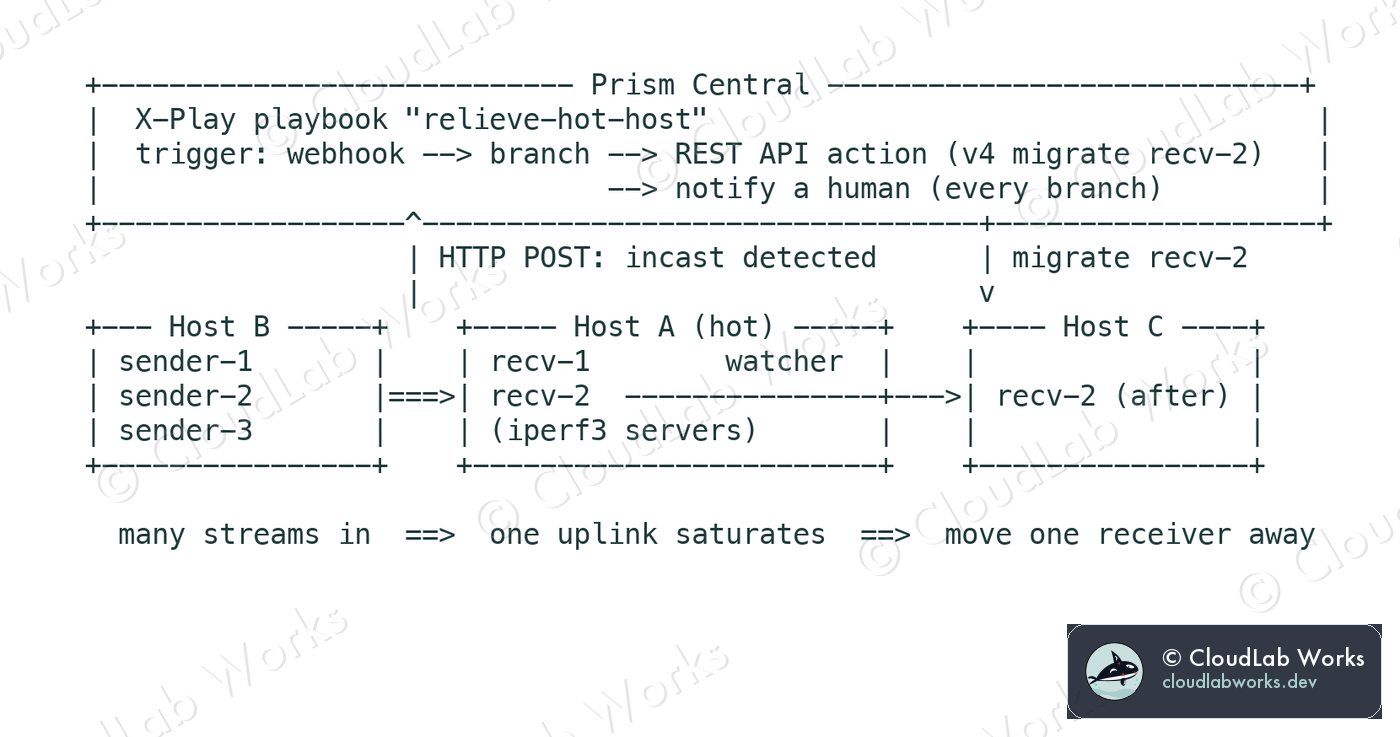
Three parts, each doing one job:
- Load: several sender VMs blast two receiver VMs that sit on the same host.
- Detect: a small watcher notices the host is receiving from many sources at once, above a threshold, for longer than a short burst.
- Act: the watcher calls an X-Play webhook. The playbook moves one receiver VM to a quieter host through the v4 API and tells a human what it did.
Why moving a VM fixes it (and what wouldn't)
Incast is a fan-in problem at the receiving end. Moving a sender does nothing, because the traffic still converges on the same uplink. Moving the receiver that's sharing the hot uplink splits the fan-in across two hosts, so each uplink carries roughly half.
That is the design choice the demo makes on purpose: two receivers co-located on Host A, so there is something that a migration genuinely relieves. If your real incast is one VM receiving from fifty, migration only moves the problem; the fix there is spreading the workload or shaping the senders. Know which one you have before you automate it.
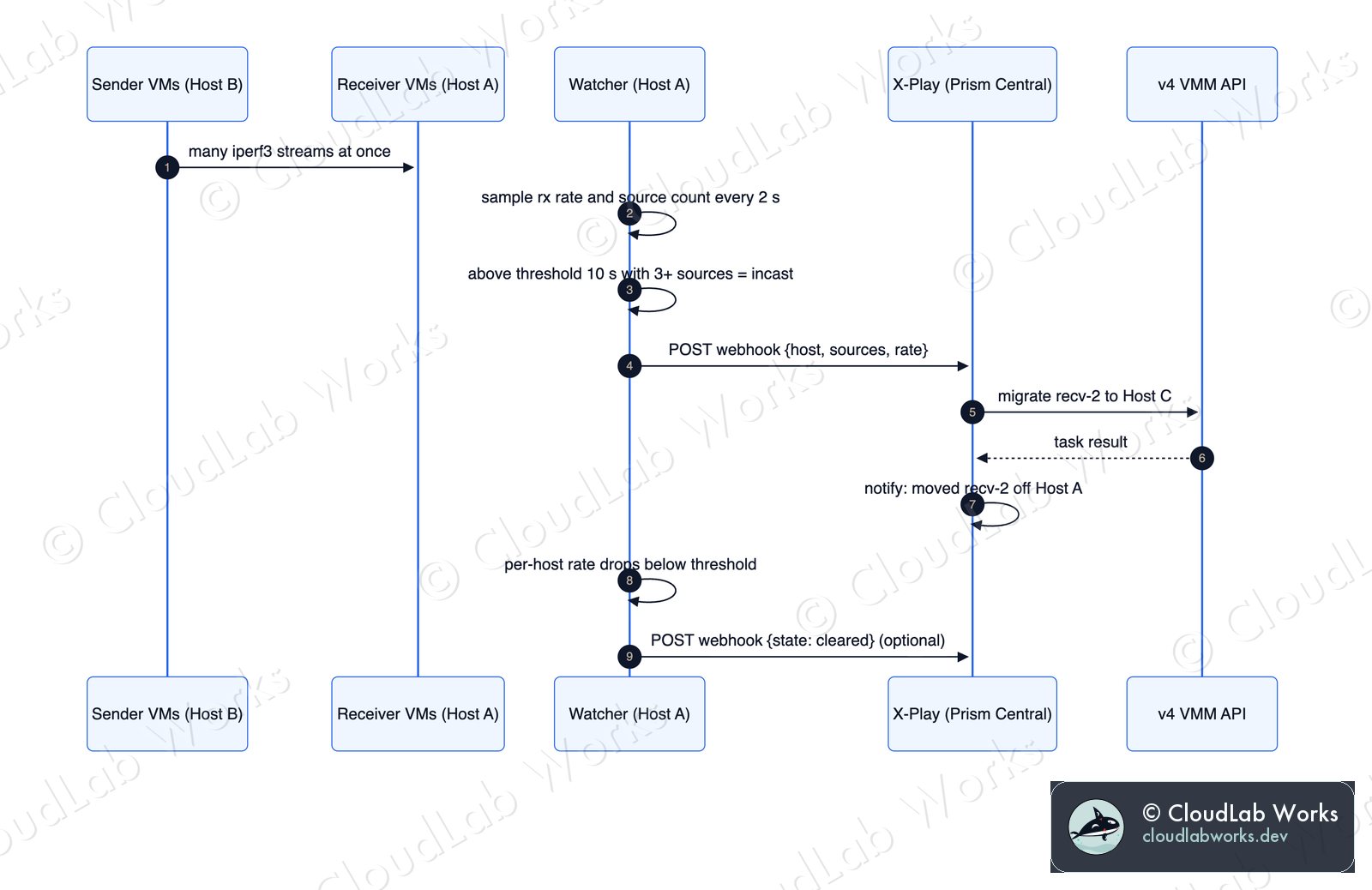
The flow, step by step
The detector: keep it boring
The watcher doesn't need to be clever. Every two seconds it reads received bytes and counts distinct remote sources with established connections. It fires only when both are true:
- receive rate stays above the threshold (say 80% of the measured link ceiling) for 10 seconds, and
- three or more distinct sources are sending.
The second condition is the important one. A single large copy saturating a link is normal; that is not incast. Requiring several sources is what separates a busy host from a pile-up.
The ten-second hold stops it reacting to every microburst. Automation that migrates VMs on noise is worse than no automation.
If your switches export sFlow, you can do the detection in the network instead and get per-port, per-path detail without touching the hosts. The idea for this exercise came from the sFlow team's Detecting incast congestion of RDMA flows and their open-source ai-monitor proof of concept. It flags a leaf egress port above 80% with more than one sender, then traces every colliding flow back across the fabric to its source. Their demo targets RoCEv2 RDMA between GPUs. The same logic should carry over to plain TCP fan-in by keying on the 5-tuple instead of the RDMA queue pair; that part is our extension and has not been tested yet.

The X-Play half of the design doesn't change: host watcher or sFlow, whatever detects it ends in the same webhook. The host watcher is the path for a hosted PoC, where the switches can't be configured.
The X-Play side
X-Play is the automation engine built into Prism Central. A playbook is a trigger plus actions. Two parts of it make this work:
- Webhook trigger. Once a playbook with a webhook trigger is saved, it shows the API method, URL, ID and body to call from outside. Any script can now start the playbook.
- REST API action. Lets the playbook call an API, including Prism Central's own v4 API, so it can migrate a VM even if there is no dedicated button for that exact step.
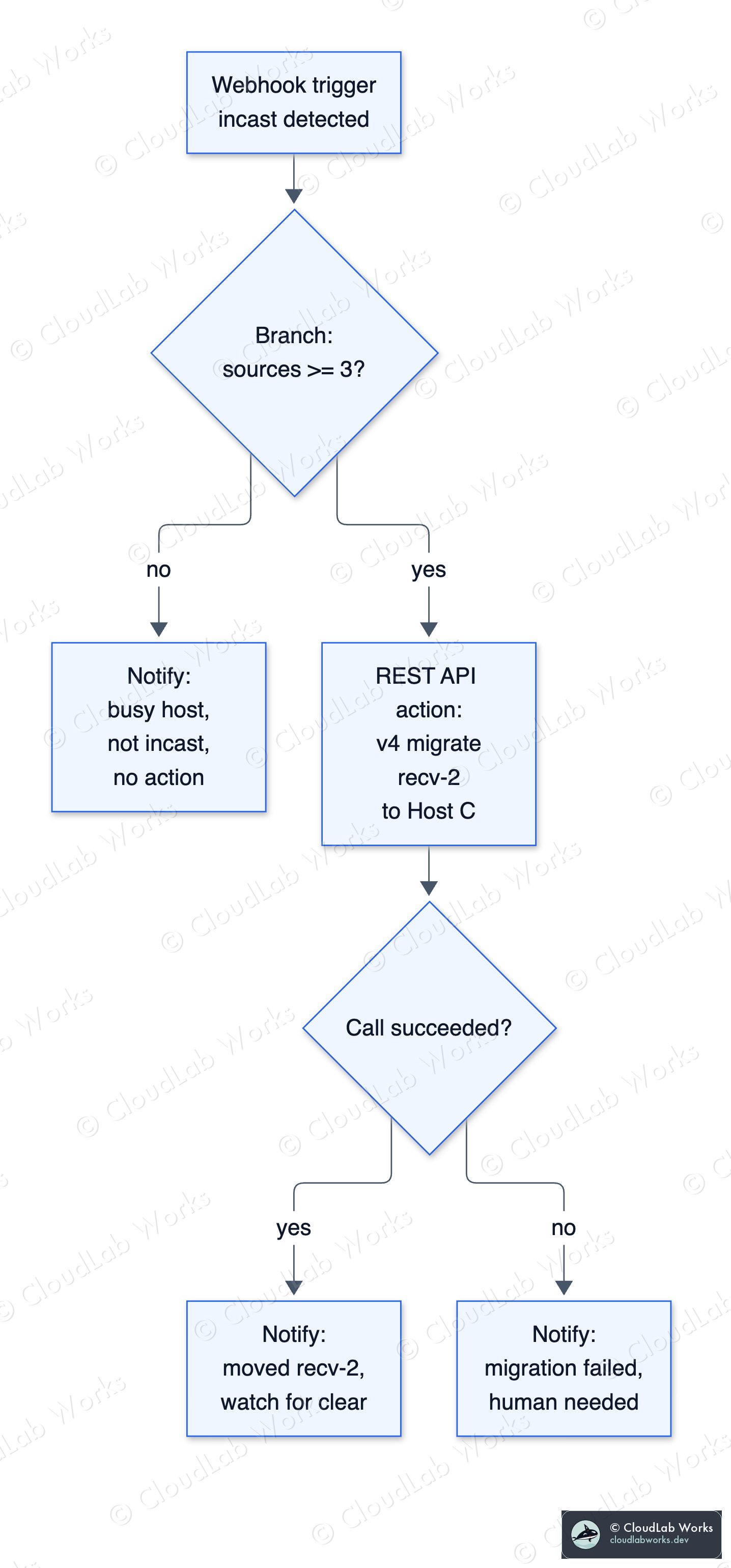
The playbook, as designed:
Two guardrails worth keeping even in a demo:
- Act once. The playbook moves one VM per event. If the watcher fires again within a cooldown window, it only notifies. Automation that keeps reacting to its own side effects ends badly.
- Always tell a human. Every branch ends in a notification, including the "did nothing" branch. Silent automation erodes trust faster than slow automation.
Proving it worked
Claims are cheap; timelines aren't. The write-up for each run records:
| Time | What the watcher saw | What X-Play did |
|---|---|---|
| T0 | baseline, 1 source | nothing |
| T0 + 30 s | load starts, 6 sources | nothing (hold timer) |
| T0 + 40 s | above threshold 10 s, 6 sources | webhook fired |
| T0 + 40 s + n | migrate recv-2 to Host C | |
| after migration | Host A rate roughly halves | notify sent |
The numbers in that table are placeholders until the recorded run fills them in. The shape is what matters: detection, one action, measured relief.
What this exercise is actually teaching
The network part is the excuse. The real lesson is the loop: detect a specific pattern, take one reversible action, notify, and verify the effect. Swap incast for a full disk, a runaway VM or a noisy neighbour, and the shape doesn't change. X-Play is a good place to learn it because the trigger, the action and the audit trail all live in the same console.
Next: the recorded run, with the real timeline filled in.
Personal blog. Alex works at Nutanix; the opinions here are his own and nothing here is Nutanix confidential: every fact is public or his own field experience.
Follow along
Get the next post without leaving this page: copy the feed into any reader, or get it by email. Live builds and the lab's music stream on Twitch.
 Ask Waku
Comments