


Invisible Wires: Agentic Cloud
Who sent this agent? Agent Name Service, read as an architect
A payment agent receives an instruction to wire $50,000 to a supplier's invoicing agent. Two questions decide whether the money moves. Does that agent actually belong to the supplier? And if it does, is it still running the code it ran last month?
That is the opening scenario of the Agent Name Service specification, and it is the right place to start. Agent-to-agent traffic already exists. What does not exist yet is a standard way for one agent to check who is on the other end.
What ANS is
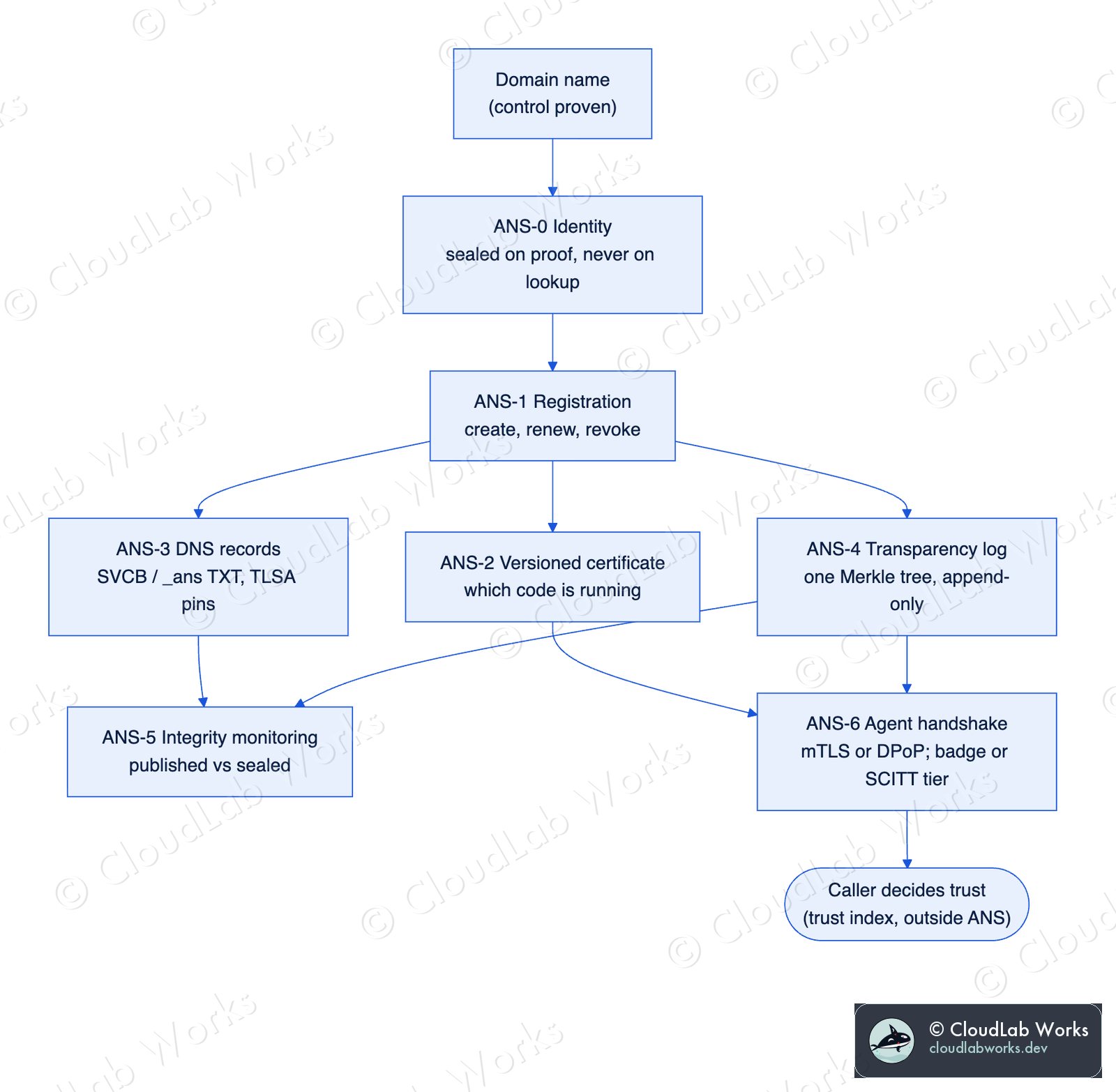
ANS is an open draft standard, Apache 2.0, published at github.com/agentnameservice/ans-spec. It builds on an OWASP paper by Narajala, Huang, Habler and Sheriff, contributed to the IETF as draft-narajala-ans. The specification is split into seven layers.
| Layer | Settles |
|---|---|
| ANS-0 Identity | The agent is anchored to a domain name, sealed only after control of that domain is proven |
| ANS-1 Registration | How a registration is created, renewed and revoked |
| ANS-2 Versioned naming | A certificate bound to the agent's version, so the certificate says which code is running |
| ANS-3 DNS publication | The DNS records an operator publishes so others can find and pin the agent |
| ANS-4 Transparency | Every lifecycle event appended to one Merkle-tree log that cannot be rewritten |
| ANS-5 Integrity monitoring | Workers that keep checking the published records against what was sealed |
| ANS-6 Agent authentication | How two agents prove themselves to each other at connection time |
Proof, not lookup
The most important line in the set is in ANS-0: the Registration Authority seals an identity "only after control of the identifier is proven, never on resolution alone."
The spec is candid about why. Its own earlier draft, v0.1.0, treated identity as resolution: fetch the key an identifier publishes and call that the identity. The authors' example shows the flaw. Resolving did:web:google.com returns Google's real key and says nothing about who is registering. Version 0.2.0 retired that model. Resolution is now only one internal step of a control proof, and nothing is sealed until the registrant demonstrates possession of the key for this specific operation.
The domain is mandatory. The legal entity behind the agent, which the spec calls a Verified Identity, is optional. "The who is optional; the what is not."
The registry records; the caller decides
ANS-0 describes the Registration Authority as "a notary, not a judge." It verifies control and seals events. It does not rate agents by risk. Trust scoring is pushed out to a separate specification, the trust index, which consumes ANS data.
That split is sound architecture. The party that records evidence and the party that judges it have different failure modes, and fusing them gives one compromise two jobs. It also sets a clear limit on what ANS promises. In the $50,000 scenario, ANS can tell the payment agent that the invoicing agent really is the supplier's, running a known version. It cannot tell the payment agent that the supplier's invoice is correct.
Built to be checked
Two details show the authors expect independent implementations to be compared.
ANS-3 defines the DNS record set as a pure function of the registration: no I/O, no context, no error. Two conformant implementations must produce the same records, apart from TTL. The default profile publishes SVCB records per RFC 9460; the older _ans TXT family remains as an opt-in.
ANS-4 keeps one transparency log, a single Merkle tree, with every agent and identity event appended in order. ANS-6 then gives a connecting agent two ways to use it: the badge tier, which queries the log at connection time, and the SCITT tier, which verifies receipts offline. Possession is proven over mTLS with the version-bound certificate, or with an RFC 9449 DPoP proof when a proxy sits in the path.
Where it stands
Every core document is marked DRAFT. ANS-0 is version 0.2.0, dated June 2026, and it changed its core identity model between versions. That is a reason to read it now and to build on it later.
Where CloudLab Works stands
CloudLab Works intends to be an early implementer. The plan is to anchor the lab's own agents to cloudlabworks.dev, publish their ANS records, and report what holds up and what breaks against a draft that is still moving. A standard for agent identity gets better when someone runs it before it is finished, and the cost of doing so on a lab domain is a few DNS records and an honest write-up.
Follow along
Get the next post without leaving this page: copy the feed into any reader, or get it by email. Live builds and the lab's music stream on Twitch.
 Ask Waku
Comments